3d Printing How To Reduce Stringing

3d printing how to reduce stringing
The most common setting that is used to combat excessive stringing is something that is known as retraction. If retraction is enabled, when the extruder is done printing one section of your model, the filament will be pulled backwards into the nozzle to act as a countermeasure against oozing.
How do you stop PLA stringing?
Tips to Avoid Stringing
- Tip 1: Dry PLA.
- Tip 2: Clean the Nozzle.
- Tip 3: Lower the Print Temperature.
- Tip 4: Activate Retraction.
- Tip 5: Optimize Retraction Settings.
- Tip 6: Raise Travel Speed.
- Tip 7: Deactivate Z-Hop.
- Tip 8: Activate Wipe.
How do you reduce retraction in 3D printing?
Ideally, you want to use the fastest functional speed to reduce stringing and print time. For reference, your slicer's default retraction speed will likely lie between 30 and 60 mm/s. If this value isn't working for your printer, try adjusting the speed in 5-mm/s increments.
What causes stringing on PLA?
Temperature. A common cause of persistent PLA stringing, or other materials; is a print temperature that is too high. When the temperature in the print head is too high for the material being used, the filament becomes too viscous and watery and leaks out the print nozzle.
Why are my 3D prints so stringy?
Stringing happens when small strings of filament are left behind on a 3D printed object. This is typically due to filament dripping out of the nozzle while the extruder is moving to another location.
Is combing worth it 3D printing?
Combing will reduce the chance of defects on outer surfaces of the print by recalculating all nozzle travel moves to stay within the perimeter of the print. This results in greater travel distances, but with a reduced need for material retraction.
How do I get a smooth finish with PLA?
PLA parts can be finished with a coat of epoxy like XTC-3D from Smooth-On. This will smooth out the part and give it a pretty nice shine. I've also had a fair amount of success sanding prints, giving them a coat of automotive filler primer, and using glossy spray paint.
What does too much retraction look like?
Too much retraction results in little gaps, or even globbing due to air pockets within the print head. When your printer does not retract enough, visible oozing will occur as the nozzle travels. You will see filament stringing between features as your nozzle is not stopping material extrusion before moving.
Does wet filament cause stringing?
Wet filament can cause stringing because the extra moisture absorbed by the material ends up evaporating within the printer nozzle, causing a buildup of pressure that forces out the molten plastic in unwanted places. To prevent this issue, filament should be stored in a sealed container with a desiccant.
Does coasting reduce stringing?
Coasting in Cura mainly aims to solve stringing issues in a 3D print. This phenomenon typically occurs because the material isn't retracted completely back into the nozzle. Thus, the material that oozes out of the nozzle forms zits or blobs on the 3D print.
Is 10mm retraction too much?
As a rule of thumb, the retraction distance should not exceed the length of your nozzle. Depending on the type of extruder, many printers use a value between 2 and 7 mm (e.g. the Ultimaker Cura retraction length is 6.5 mm at 25 mm/s, this is for a Bowden style extruder).
Can flow rate affect stringing?
Too high a flow rate can lead to over-extrusion in 3D printing because the plastic filament is forced through the extruder nozzle too quickly. This results in too much material being extruded from the nozzle. This can lead to problems such as stringing.
Can humidity cause stringing for 3d printing?
High relative humidity (RH) will cause stringing, popping, and poor mechanical properties. We have observed the best print quality below 45 % relative humidity (RH). At levels above 55-60 %, you will likely see problems. At 75 % and above your print will likely be very stringy, if it is successful at all.
What is a good retraction speed for PLA?
Faster retraction speeds can help prevent oozing and stringing while also reducing overall print times, but excessive speed can lead to other issues such as filament grinding. As with other FDM printers, the safest Ender 3 retraction speed is in the range of 30–50 mm/s.
Can nozzle cause stringing?
Stringing from material left on the nozzle If you print for a long time from a single type of filament, such as PET-G, the filament can create a thin layer in the nozzle. This can cause stringing as the strands of the filament stick to the surface of the print.
How do I make super smooth 3D prints?
Another way to achieve a smooth surface on a print is by adding an additional coating of material, whether sprayed, painted, or dipped. This can fill any defects in the surface texture, including layer lines, and leave a shiny, even finish. Two common examples for PLA are using a paint primer or an epoxy coating.
How do you stop stringing in Ender 3?
One of the easiest ways to avoid over-extrusion, including stringing, is to lower your nozzle printing temperature. Lowering the temperature reduces the pressure inside the hot end, thus reducing the amount of excess filament that flows out the nozzle.
What temperature should I print PLA+?
We recommend an extruder temperature of 200°C for PLA and 210°C for PLA+. While PLA/PLA+ can be printed on an unheated bed, for best results we recommend and a bed temp of between 50°C - 60°C. If poor adhesion is an issue, print the first two layers ONLY with the bed at 65°C (and 60°C for every subsequent layer).
Is it better to 3D print multiple parts at once?
3D printing multiple objects at the same time is a dream come true. You can print as many models that can fit the build plate, therefore, reducing the time and work required. It also allows your objects to cool faster since they can be left to cool while the next model is being printed.
Is it better to 3D print fast or slow?
The general rule of thumb for 3D printing is slower speeds will yield higher quality. The speed you go with depends on what part you are creating. Do you need a strong part where looks don't matter but quick printing time does, or do you want a part with perfect dimensional accuracy and little to no surface blemishes.
11 3d printing how to reduce stringing Images
Futuristic racquet produced with Windform 3D Printing and Additive

String Art Art Diy Antonio Mora Artwork 3d Printing Portrait Gods

3D printing 3d Printing Jewelry Design Rings For Men Work Prints

Printing Curves not Layers Make Prints 3d printing 3d printing

How To Reduce Costs Of 3D Printing Tips From Professional User 3d

3d Printing News 3d Printing Business 3d Printing Diy 3d Printing

Pin by Ethan Watters on 3D printed material in 2022 3d printing

Mechanical Engineering Design Mechanical Design Planer Cad 3d
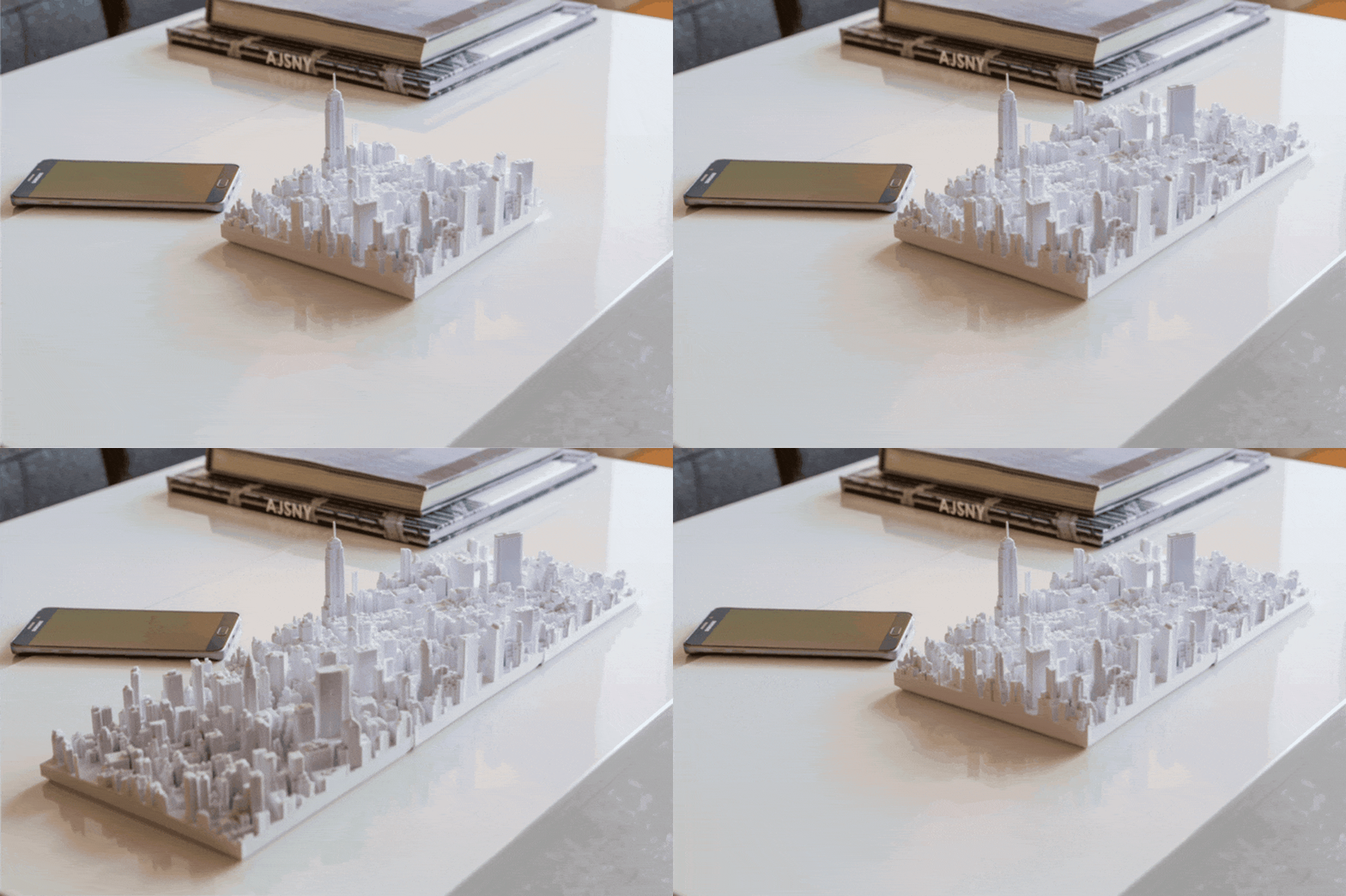
These Minimal 3DPrinted Tiles Are The Perfect Cityscape Ornament

Stringing or Oozing Print quality 3d printing 3d printer

Post a Comment for "3d Printing How To Reduce Stringing"