How To Find Voltage Across An Inductor

How to find voltage across an inductor
Now we have an inductor with its i- v equation: v = L d i d t v = \text L\,\dfrac{di}{dt} v=Ldtdi. This tells us the voltage across the inductor is proportional not to current but rather the rate of change of current through the inductor.
How do you find the voltage across an inductor in a RL circuit?
We can find the time dependence of the induced voltage across the inductor in this circuit by using VL(t)=−L(dI/dt) and Equation 14.5. 3: VL(t)=−LdIdt=−ϵe−t/τL.
What is the voltage drop across an inductor?
However, the voltage drop across the inductor, VL will have a value equal to: Ve(-Rt/L). Then the voltage across the inductor, VL will have an initial value equal to the battery voltage at time t = 0 or when the switch is first closed and then decays exponentially to zero as represented in the above curves.
How do you find the RMS voltage across an inductor?
This inductance. So we get that's also provided here so we can find that one out now let's see how
Is there a voltage difference across an inductor?
The potential difference across an inductor depends on the rate of change of the current. When you have an inductor with constant current i flowing from a to b, there is no potential difference. The potential difference across an inductor depends on the rate of change of the current.
How do you calculate voltage across a resistor?
Now that we know the amperage for the circuit (remember the amperage does not change in a series circuit) we can calculate what the voltage drops across each resistor is using Ohm's Law (V = I x R).
What is the voltage across the inductor at t 0?
If a constant current flows in an inductor, then d i / d t = 0 di/dt = 0 di/dt=0d, i, slash, d, t, equals, 0, so there is zero voltage across the inductor.
How do you find the current across an inductor?
The formula which calculates the inductor current based on these input parameters is I= 1/L∫Vdt, where I is equal to the current flowing through the inductor, L is equal to the inductance of the inductor, and V is equal to the voltage across the inductor. Many times, you will see the extended formula, I= I0 + 1/L∫Vdt.
How do you find the value of an inductor?
L = μN2A/l
- L = Inductance (H),
- μ = Permeability (Wb/Am),
- N = The coil's number of turns,
- A = The coil's circumference,
- l = Length of coil (m).
How do you calculate voltage drop in an RLC circuit?
For a series RLC circuit, and impedance triangle can be drawn by dividing each side of the voltage triangle by its current, I. The voltage drop across the resistive element is equal to I*R, the voltage across the two reactive elements is I*X = I*XL – I*XC while the source voltage is equal to I*Z.
Do inductors generate voltage?
The inductor, however, hates change and will try to oppose this change in magnetic flux inducing a voltage.It will be like a battery with the polarity the wrong way.So that is 'why' the voltage is induced.
Can the voltage drop across the inductor or capacitor?
Yes; the voltage drop across the inductor or the capacitor in a series LCR circuit can be greater than the applied voltage of the a.c. source beacuse as VC and VL have opposite faces, VC or VL may be greater than V.
What is the RMS voltage in a series RL circuit?
In a series RL circuit, 12V rms is the voltage across the resistor, and 14V rms is the voltage across the inductor.
What is RMS current and RMS voltage?
RMS or root mean square current/voltage of the alternating current/voltage represents the d.c. current/voltage that dissipates the same amount of power as the average power dissipated by the alternating current/voltage. For sinusoidal oscillations, the RMS value equals peak value divided by the square root of 2.
What is Vrms and IRMS?
The RMS value is the square root of the mean (average) value of the squared function of the instantaneous values. The symbols used for defining an RMS value are VRMS or IRMS. IRMS - The current in an alternating current circuit varies continuously in direction and magnitude.
What is the voltage across the inductor just after the switch is closed?
When this happens, the current is no longer changing, so the voltage across the inductor is zero.
What is the voltage of inductance?
In the SI system, the unit of inductance is the henry (H), which is the amount of inductance that causes a voltage of one volt, when the current is changing at a rate of one ampere per second.
How do you find the voltage across a resistor without current?
You can pick up the resistors and move them around, and you'll still have the same voltage across each one. We'll use an example circuit with three resistors in series: R1, R2, and R3. ... With basic algebra, we can change Ohm's Law to solve for voltage instead of current:
- I = V / R
- IR = VR / R
- IR = V.
- V = IR.
How do you find the voltage across a resistor in parallel?
Now another equation i'm going to use is v squared divided by r in a parallel circuit the voltage of
How do you calculate total voltage?
How do you calculate voltage in a series circuit? Voltage for each circuit element in a series circuit can be calculated by applying Ohm's law: V=R*I. Also, if the element's resistance is unknown, the Kirchhoff loop rule helps to calculate the voltage across such a circuit element.
13 How to find voltage across an inductor Images
LR Transient Curves Electronics circuit Inductor Circuit

RLC Series Circuit Circuit theory Basic electrical engineering

Inductor Coupling and Series Parallel Combinations Series Parallel

inductive circuit Inductors Inductor Circuit

Inductor and the Effects of Inductance on an Inductor Inductor

1704 best electr images on Pinterest Electronics projects Arduino

Mutual Inductance Mutual Inductors Self
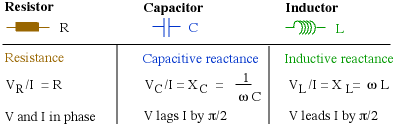
Pin by Nicole Greenheck on Alternating Current Circuits Equations

ResistorInductorCircuit is an electric circuit composed of resistors

Function of inductors Follow me electronicsforall3 Inductors

Basic Inductor Symbols Inductors Electronics basics Inductor

Mechanics with animations and film clips Physclips in 2023 Physics

Post a Comment for "How To Find Voltage Across An Inductor"