Thevenin Voltage Calculator

Thevenin voltage calculator
To calculate the Thevenin equivalent voltage, the load impedance is open-circuited. And find an open-circuit voltage across the load terminals. Thevenin equivalent voltage (Veq) is equal to the open-circuit voltage measured across two terminals of load.
What is the Thevenin voltage Vth?
The Thévenin equivalent voltage is equal to this open circuit voltage: VTh = VAB. (b) If the circuit does not contain any dependent voltage sources or dependent current sources, calculate the equivalent resistance between terminal A and terminal B. RTh is equal to this equivalent resistance.
How do you calculate Vth?
Open the load resistor. Calculate / measure the open circuit voltage. This is the Thevenin Voltage (VTH). Open current sources and short voltage sources.
Where is the Vth in Thevenin's theorem?
The process for analyzing a DC circuit using Thevenin's Theorem requires the following steps: Find the Thevenin Resistance by removing all voltage sources and load resistor. Find the Thevenin Voltage by plugging in the voltages. Use the Thevenin Resistance and Voltage to find the current flowing through the load.
How do you calculate RTH in a circuit?
So since we have B th now we are in a position to find out rth in the next slide we will see how to
What is the value of Vth?
Vth is calculated by opening the specified terminal. Using voltage divider, Vth= 2*10/(2+1)=6.67V. On drawing the Thevenin equivalent circuit, we get Rth, 4 ohm and Vth in series.
What is Thevenin theorem formula?
Any combination of batteries and resistances with two terminals can be replaced by a single voltage source e and a single series resistor r. The value of e is the open circuit voltage at the terminals, and the value of r is e divided by the current with the terminals short circuited.
What is the Thevenin equivalent VTH and RTH for the circuit given?
Vth = 6.3V. Rth = (470+220)//(680+560). Rth = 443 ohm. So, option 1 is right.
What is Thevenin theorem with example?
Thevenin's Theorem states that it is possible to simplify any linear circuit, no matter how complex, to an equivalent circuit with just a single voltage source and series resistance connected to a load.
How do you solve the problem with Thevenin theorem?
Steps to follow for solving problems by Thevenin's Theorem
- Identify the load (RL). Step 2 :
- Remove the load and calculate the open-circuit voltage (VTH). Step 3 :
- To calculate Thevenin's impedance (RTH), replace the sources with their internal impedance. Step 4 :
How do you find Thevenin impedance?
To replace a network by its Thevenin equivalent, compute the Thevenin voltage: the output of the voltage divider formed by Z1 and Z3 . The Thevenin impedance is the impedance looking back from AB with V1 replaced by a short circuit and is therefore a a series-parallel combination. VTh = e = V at degrees.
Why we use Norton's theorem?
The Norton equivalent circuit is used to represent any network of linear sources and impedances at a given frequency. Norton's theorem and its dual, Thévenin's theorem, are widely used for circuit analysis simplification and to study circuit's initial-condition and steady-state response.
Why is Thevenin theorem used?
Thévenin's theorem can be used to convert any circuit's sources and impedances to a Thévenin equivalent; use of the theorem may in some cases be more convenient than use of Kirchhoff's circuit laws.
How do I convert Thevenin to Norton?
Thevenin voltage is equal to Norton's current times Norton resistance. Norton current is equal to Thevenin voltage divided by Thevenin resistance.
What is ETh in Thevenin?
ETh is the open circuit voltage at the terminals, • ZTh is the input or equivalent resistance at the terminals when the independent sources are turned off. Determining ETh Remove the load (open-circuit) and measure the resulting voltage.
What is Norton's current?
The Norton equivalent circuit represents a general circuit with an independent current source in parallel with the Norton equivalent Resistance. Norton current source ( ) is equivalent to the short-circuit current at the terminal a and b. Norton resistance is th e same as the Thévenin resistance.
Can we apply Thevenin's theorem to AC circuit?
Thevenin's Theorem Statement Similar to the DC circuits, this method can be applied to the AC circuits consisting of linear elements like resistors, inductors, capacitors. Like thevinin's equivalent resistance, equivalent thevinin's impedance is obtained by replacing all voltage sources by their internal impedances.
How do you find Thevenin equivalent circuit with dependent source?
So really the procedure is the same to find the Thevenin voltage we need to find the open circuit
How are Norton's theorem and Thevenin's theorem related?
Norton's theorem is converse of Thevenin's theorem The candidates who will clear the Psycho Aptitude Test will have to through Document Verification, and Medical Examination before the final selection.
What is Thevenin's equivalent impedance?
Thevenin's Theorem is a technique that allows us to convert a circuit (often a complex circuit) into a simple equivalent circuit. The equivalent circuit consists of a constant voltage source and a single series resistor called the Thevenin voltage and Thevenin resistance, respectively.
12 Thevenin voltage calculator Images
HT106B Socket Outlet Tester Circuit Polarity Voltage Detector Wall Plug

Calculator App Icon Ios app icon design App icon App icon design

Pin on Electrical Resources and Calculators

LM317 VOLTAGE Calculator Calculator Guitar effects Vacuum tube

RMS Voltage Calculator Good Calculators Rms Triangle wave Calculator

Calculate the Voltage across Voltmeters of Thermocouple Calculator

Pin on Refinance

How to build an HTML calculator app from scratch using JavaScript

Intrinsic Value Value Stocks Retirement Advice Warren Buffett
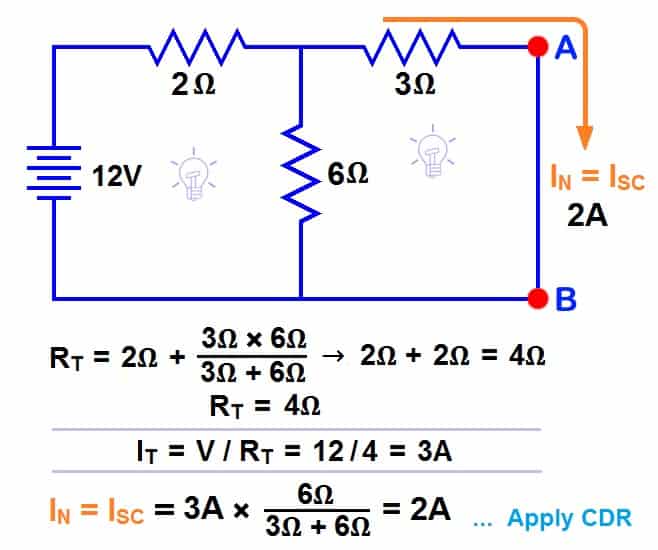
norton equivalent circuit examples With images Electronic circuit

And for the times when you dont have the pan you need in 2020

Post a Comment for "Thevenin Voltage Calculator"